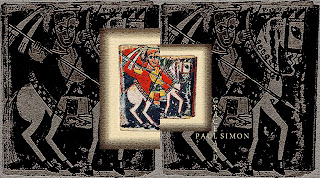
This art is derived from the designs on the covers of great music albums. The original images are mostly square which I processed to fit an 18x10 resolution computer screen. The processes I employ are simple. I am not a professional artist. Credits are given to the artists and owners of the original designs as well as the labels which released the albums. No infringement of copyright is intended in these works. I am using the original designs under the doctrine of "fair use."
This image is not from Tales from the Crypt. This is David Byron on the cover of the UK release of Uriah Heep's debut album. His cobwebbed face occupies the whole front sleeve and is here reproduced six times to fill the 18x10 canvass. The recolouring of the image at bottom right was done in order to match the letters of the band's name which, together with the album title, has been distorted with the wave filter. The album was generally panned by the mainstream critical press upon its release, although it has since been acknowledged as an early classic of the heavy metal genre. The harshest critic was Rolling Stone magazine reviewer, Melissa Mills, who began her review, "If this group makes it I'll have to commit suicide. From the first note you know you don't want to hear any more." Source
That's a rather horrific note, but a mouth agape could be making a sound begging to be heard. Byron is the lead vocalist and he wrote almost all of the songs in this album. And 46 years on the band was still touring. Down Under.
Here's David Byron not singing.
Artwork by Robin Nicol, photo by Pete Smith. Album produced by Gerry Bron. Vertigo (UK) 1970.
Uriah Heep are considered one of the most underrated progressive rock bands to come out of Britain's acclaimed classic rock era of late 1960's and early 1970's. A very diverse band, comprised of many individual talents, namely David Byron's incredible and iconic falsetto voice, Mick Box's roaring wah-wah virtuoso guitar style and Ken Hensley's raging organ, Uriah Heep never seemed to gain any recognition, not even in Britain. Though being considered a progressive rock band in every sense of the word, Heep's first studio album, Very 'Eavy... Very 'Umble, released in June 1970, is a much more diverse album in style, ranging from blues to hard rock and heavy metal. Critics quickly dismissed any potential of Uriah Heep becoming big, but regardless of critics, Very 'Eavy... Very 'Umble presents itself as a promising debut. More
The album's US release (Mercury 1970) has a different album sleeve design, also by Robert Nicol.
This work is an experiment with the glass distortion and liquefy filters. The basis I chose is the album cover version which has pink instead of the more common dayglo red for the band's letters. It's the pink as in punk that created the rush to add the bright blue bar at left and supplied the devilish creative adrenalin to arouse the X and drop the O. One can have it any which way but Jamie Reid's original album art has already gone down in history as one of the standards of punk visual aesthetic. Here's the original album cover art design.
No. 29, The Virgin all-Time Album Top 1000; No. 29, Rate Your Music, The 100 Greatest Albums of All Time; No. 41, Rolling Stone, The 500 Greatest Albums of All Time. No. 2, Rolling Stone, The 100 Greatest Album Covers; No. 14, Music Radar, The 50 Greatest Album Covers of All Time. Design concept by Jamie Reid, phrase supplied by Steve Jones. Album produced by Chris Thomas and Bill Price. Virgin 1977.
The album was originally going to be titled God Save Sex Pistols. The album's title changed in mid-1977, based on a phrase supplied by Steve Jones. Jones said he picked up the phrase "Never mind the bollocks" from two fans who would always say it to one another. Johnny Rotten explained its meaning as a working-class expression to "stop talking rubbish".
In the UK, the album was subject to what (writer Clinton) Heylin described as "blatant acts of censorship exercised by media and retail outlets alike". London police visited the city's Virgin record stores and told them they faced prosecution for indecency if they continued to display posters of the album cover in their windows. The displays were either toned down or removed. However, on 9 November 1977 the London Evening Standard announced on its front page headline "Police Move in on Punk Disc Shops", and reported how a Virgin Records shop manager was arrested for displaying the record after being warned to cover up the word "bollocks". An obscenity case was heard at Nottingham Magistrates' Court on 24 November. The defence presented the case as a matter of police discrimination. The arresting officer was asked why the newspapers The Guardian and Evening Standard (which had referred to the album's name) had not been charged under the same act. When the magistrate inquired about his line of questioning, the defence lawyer stated that a double-standard was apparently at play, and that "bollocks" was only considered obscene when it appeared on the cover of a Sex Pistols album. The prosecutor conducted his cross-examination "as if the album itself, and not its lurid visage, was on trial for indecency. The lawyer produced expert witnesses who were able to successfully demonstrate that the word "bollocks" was not obscene, and was actually a legitimate Old English term originally used to refer to a priest, and which, in the context of the title, meant "nonsense". Full article Case closed. (A) Holidays in the Sun - Liar - No Feelings - God Save the Queen - Problems (B) Seventeen - Anarchy in the U.K. - Bodies - Pretty Vacant - New York - E.M.I.
On this work, the top fourth of the original album cover art design (from above the street lamp near the black car at right) was stretched so that the square image could fit into half an 18X10 canvass. It was pasted at right and was flipped and the flipped image was pasted at left. The first impression that one will have upon seeing this image is that it is half real and half unreal - that is, the flipped image is unreal. On closer look, the flipped image is not totally unreal, for its bottom half resembles the reflections of tree and sky on clear waters. And then I wouldn't mind answering the question why those reflections are above pedestrians' heads instead of below. But what if I saw that image in a record store and bought the album and played the record only to find that the music is playing backwards? Backmasking is a recording technique in which a sound or message is recorded backward onto a track that is meant to be played forward. It was popularised by The Beatles, who used backward instrumentation on their 1966 album Revolver. Backmasking was also used by Queen ("Another One Bites the Dust"), The Eagles ("Hotel California"), Deep Purple ("Stormbringer"), and Led Zeppelin ("Stairway to Heaven"). More
Here's the original album cover art design. A lot of rumours went with this image, mostly centred on the theory that 'Paul is dead.'
No.3, Rate Your Music, The 100 Greatest Albums of All Time; No. 8, The Virgin All-Time Album Top 1000; No. 14, Rolling Stone, The 500 Greatest Albums of All Time; No. 22, Entertainment Weekly, 100 Greatest Albums Ever; No. 32, Billboard, The 300 Best-Selling Albums of All Time. No. 26, Music Radar, The 50 Greatest Album Covers of All Time. Design by John Kosh; photo by Ian McMillan; suits by Tommy Nutter. Album produced by George Martin. Apple 1969. The procession of The Beatles across the zebra crossing, say the conspiracy theorists, represents Paul's funeral. John Lennon leads in a white suit and symbolises the preacher; Ringo Starr is the mourner, dressed in black; George Harrison, in scruffy shirt and trousers, denotes the grave-digger; Paul is wearing an old suit and is the only one who is barefoot. This, was a sign that Paul was the corpse. Paul McCartney is left-handed, but here holds his cigarette in his right hand. At the time, cigarettes were commonly referred to as 'coffin nails'. This, therefore, could be seen as a message that Paul's 'coffin lid' had been nailed down and that the man in the picture was a lookalike. Paul is also out of step with the other band members. Each of the others has his left leg forward, but Paul has his right leg forward - again marking him out as different. The VW Beetle in the background has the registration LMW 28IF - 28 being the age theorists say Paul would have been if he hadn't 'died'. In fact, Paul was 27 when Abbey Road was released - but fortunately for the theorists, Indian mystics count a person's age from conception, not birth, in which case Paul would have indeed been 28 at the time. The band were famous followers of the Indian guru, Maharishi Mahesh Yogi. It has also been suggested that the LMW stands for 'Linda McCartney Weeps' - referring to his new wife whom he had married earlier that year. More The fadeout of "Strawberry Fields Forever" has John Lennon seemingly saying "I buried Paul." The image of the Beatles on the crossing has become one of the most famous and imitated in recording history. The crossing is a popular destination for Beatles fans. In December 2010, the crossing was given grade II listed status for its "cultural and historical importance"; the Abbey Road studios themselves had been given similar status earlier in the year. In 2013, Kolkata (India) Police launched a traffic safety awareness advertisement against jaywalking, using the cover and a caption that read: "If they can, why can't you?" More (A) Come Together - Something - Maxwell's Silver Hammer - Oh! Darling - Octopus's Garden - I Want You (She's So Heavy) (B) Here Comes the Sun - Because - You Never Give Me Your Money - Sun King/Mean Mr. Mustard/Polythene Pam/ She Came In Through the Bathroom Window - Golden Slumbers/Carry That Weight/The End - Her Majesty